
Does your website get traffic and leads, but still struggle to turn a steady profit?
Or are you stuck trying to get a website redesign signed off?
Either way, to get to the bottom of these issues, you must track how much money you put into and get out of your website by measuring its return on investment (ROI).
In this article, we:
- Explore why website maintenance ROI is so important
- Help you calculate website ROI with some simple worked examples
- Show you how to boost your ROI right now
|
TL;DR – Key Takeaways
|
🧮 Click here to skip ahead if all you need is an ROI calculator!
What Is Website ROI (Return on Investment)?
Your website’s ROI measures the revenue it generates compared to its costs over a fixed period of time. It’s calculated by subtracting design, development, marketing, and maintenance costs from the revenue your website brings in.
Tracking your website’s ROI helps you:
- Justify the time and money you invest in it
- Spot areas for cost reduction and performance improvement
- Plan strategies for customer retention and sustainable revenue growth
The value of your website
To measure your website’s ROI, think about its tangible and intangible returns.
Here are some examples of what we mean:
| Tangible Returns | Intangible Returns |
| Sales and lead conversions | Stronger brand visibility |
| Cost savings (reducing the need for direct marketing) | More credibility and trust with customers |
| Efficiency improvements (streamlining your sales funnel) | More loyalty and deeper customer relationships |
Throwing money at tangible improvements creates short-term wins, but without strong intangibles, it may be tricky to recover from reputational damage caused by, say, data leaks or product quality issues.
Now, let’s break your site’s returns into three main categories: revenue generation, cost savings, and brand equity.
How your website impacts revenue generation
Your website’s revenue funnel can be quite complex, with several interconnected steps from an initial search to the final sale. It’s worth learning how they connect so you can forecast your site’s profitability.
Here’s a roadmap for a B2B company:
| Level | Metric | In brief | Example |
| 1 | SEO rankings and AI share of voice | How visible are you in relevant search results? | 100,000 impressions per month |
| 2 | Traffic | What’s your click-through rate? In other words, how many people click on your website from search results? | 3,000 new visits |
| 3 | Leads | How many visitors initiate the sales process (i.e., with a demo)? | 100 new leads |
| 4 | Sales | How many direct sales are made from your leads? What’s your lead-to-sale ratio? | 25 sales made |
| 5 | CLV (customer lifetime value) | How much money do you make per customer over the average time they spend with you? | $50,000 ($2,000 per customer) |
Breaking down each step helps you understand where to make changes to improve profitability.
For example, to boost sales numbers, you can:
- Tweak your SEO (search engine optimization) strategy to improve visibility
- Test different links and meta descriptions to see which generates the most clicks
- Tweak and test landing pages to contain more provocative calls to action to boost leads
- Publish more authoritative content
How your website drives cost savings
Valuable websites save businesses money by:
- Answering visitor questions and reducing calls/emails
- Qualifying leads and reducing dependency on other sales touchpoints
- Streamlining sales funnels
- Improving operational efficiency (e.g., through self-service options like a knowledge base or calendar booking)
How your website affects brand equity
Brand visibility, credibility, and awareness are tricky to measure and quantify. You could start by tracking:
- Branded SEO keywords vs. competitors
- Repeat purchase rates
- Your net promoter score (NPS)
- Direct hits to your website’s URL
- Results of post-sale surveys
- Consistent organic growth on email marketing and social media channels
You can then apply a dollar value to your brand equity gains, or seek specialists to quantify your overall brand value.
Why Is Website ROI Important?
Your website ROI shows whether it’s helping your business grow – or quietly draining it.
Tracking website maintenance ROI from the outset enables you to assess performance, identify areas for improvement, and justify additional investments and enhancements. It proves that your website resonates with buyers, competes well in search results, and saves internal effort (or that it doesn’t and it needs work, pronto!).
For instance, a lean, focused sales funnel might be cheap, but without the right messaging and regular traffic, it’s not contributing to profitability and needs to be revised. No matter how affordable maintenance seems at first glance.
With a clear ROI (or ROI forecast), it’s easier to sign off on hiring experts with your stakeholders whenever you need to upgrade your site, be that:
- Introducing a new, mobile-friendly design
- Reducing maintenance costs by working with an agency
- Optimizing your PPC and paid social media marketing
- Enhancing user experience by improving load speeds and navigation
How To Calculate Website ROI Percentages
To calculate your website’s ROI, you deduct costs from benefits and revenue, then work out a percentage figure.
The website ROI formula
The basic website ROI formula is:
ROI = ((Website Benefits – Website Costs) / Website Costs) x 100
This calculation gives you a percentage figure: A score of 0% is breaking even, anything above 0% is profitable, and anything below is loss-making.
Here are the benefits and costs to include in your calculation:
| Typical Benefits | Typical Costs |
|
|
You should always measure your benefits and costs over the same period for an accurate valuation. So, let’s say, over a year, your benefits equal $120,000, and you have $40,000 in costs. Let’s build the formula:
(($120,000 – $40,000) / $40,000) x 100
Total ROI = 200%
Your website is driving 200% in value, so it’s healthy.
Tip: If you use the ROI formula to compare your website’s current performance with its expected performance after a big change, use incremental benefits and costs. This helps you focus on the extra value of the investment compared to the current situation.
What is a good ROI for a website?
A good ROI for a website depends on the business model, size, and industry.
That said, you can use these as benchmarks:
- Above 10% is typically considered acceptable
- Above 50% is strong profitability
- Above 200% is excellent profitability
It’s more important to work towards growing your ROI percentage over time rather than to focus on arbitrary goals.
Two worked examples: B2B & B2C
Example 1. A B2B lead generation website for an insurance company
Insurance customers buy into long-term contracts, so we need to consider the customer lifetime value (CLV) instead of one-off revenue.
Time-frame:
1 year
Benefits:
- CLV from website sales: $440,000
- Cost savings (reduced calls and tighter audience targeting): $40,000
- Increased brand value (via industry surveys): $0
- TOTAL: $480,000
This business handles website maintenance in-house, but doesn’t have time to monitor its security and update content around the clock. It typically delegates these tasks to a single specialist and estimates costs by allocating a portion of their salary to these costs.
Due to this approach, it incurred significant downtime and recovery costs after an avoidable data breach. The company got back online after a week thanks to emergency support.
Costs:
- One-offs: $0
- Breaches, downtime, and recovery: $210,000
- Ongoing maintenance: $1,000 (in-house delegation)
- SEO and content: $57,000
- Advertising: $57,000
- TOTAL: $325,000
ROI:
((480,000 – 325,000) / 325,000) x 100
Total ROI = 47.7%
This company’s website has a healthy margin, but there’s a lot of room for growth.
The site’s ROI could be much higher if the company invested in proactive website maintenance upfront, avoiding the need to pay for emergency recovery and downtime services. It would have also protected its reputation and potentially unlocked increased brand equity.
Say that if the firm invested $6,000 over the same period on a top web maintenance agency, it would have paid an extra $5,000 on maintenance. However, the breach wouldn’t have happened, eliminating the $210,000 spent on recovery.
If we redo the formula:
((480,000 – 120,000) / 120,000) x 100
Total potential ROI = 300%
This goes to show that regular maintenance pays for itself purely by removing the threat of security-related downtime. Other benefits, such as performance boosts and content updates, help increase brand value, too.
Example 2. A B2C eCommerce site for a health food company
Instead of CLV, online storefronts need to simply consider the revenue based on the average order value.
Time-frame:
6 months
Benefits:
- Revenue: $80,000
- Cost savings (streamlined funnel, self-service features, in-house admin saved): $10,000
- Increased brand value (through improved visibility and NPS surveys): $5,000
- TOTAL: $95,000
Unlike the insurance company, this firm hired a website maintenance agency two years ago and has never suffered a serious data breach or downtime. Its customers have been able to shop whenever they please, and their reputation is solid.
Separate from ongoing maintenance, the firm also decided on a website refresh to update its branding and make shopping easier for mobile users. They avoided downtime thanks to their full-service plan that comes with a staging site.
Costs:
- One-offs: $10,000 (website redesign costs)
- Breaches, downtime, and recovery: $0
- Ongoing maintenance: $6,000 (Elite plan)
- SEO and content: $8,000
- Advertising: $6,000
- TOTAL: $30,000
ROI:
((95,000 – 30,000) / 30,000) x 100
Total ROI = 216.7%
An excellent return for an eCommerce retailer that values proactive maintenance and security.
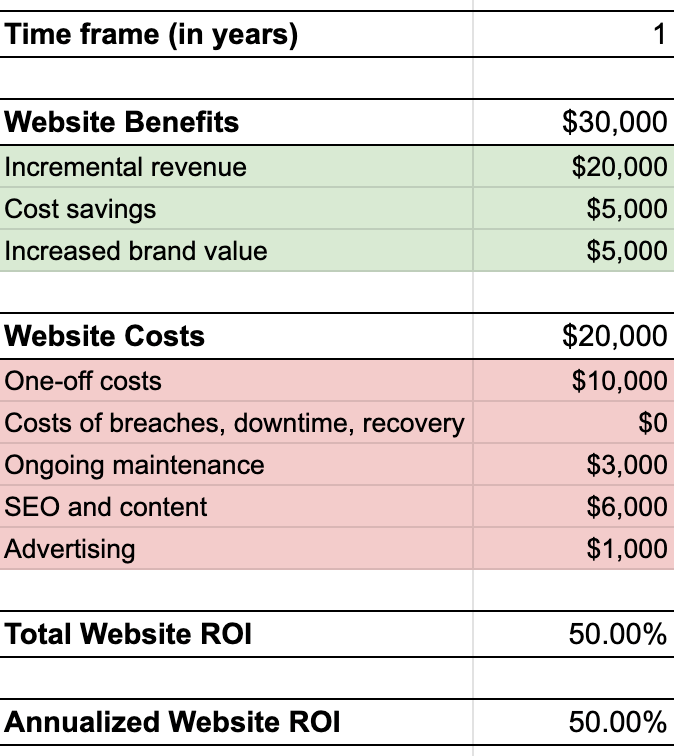
Website ROI Calculator: Try It Yourself!
You don’t have to fiddle around with all these numbers yourself. Copy our website ROI calculator and grab a quick calculation whenever you need to measure it.
How To Improve Website ROI: 5 Proven Strategies
Here are five strategies guaranteed to get your website’s ROI moving in the right direction:
- Build a lean website (initially)
- Maintain your site regularly and boost ongoing ROI
- Invest in proactive performance and security
- Create targeted content to drive high-quality traffic
- Focus on continuous conversion rate improvement
1. Build a lean website (initially)
If you’re just getting started, a lean, streamlined website that tells people what you do, why they should invest in you, and how to get in touch is more than enough.
Check out Lead Liberated’s website. This StateWP client only needs a few pages, concise copy, and donation forms to get its message across and convert visitors.

This approach keeps your web design and maintenance costs low, allowing you to add more features incrementally. If your ROI drops or plateaus, you can make changes.
Build a website you intend to run for years to come. Start slowly, and you can spread the need for pricey website redesigns over several years.
2. Maintain your site regularly and boost ongoing ROI
Redesigning your site should always be the last resort. Complete rebuilds are expensive, disruptive, and often unnecessary. Instead, measure your site’s ROI and invest in its ongoing maintenance.
A well-maintained website endures years of tweaks and updates. Its performance should be either stable or gradually improving, so plan for regular maintenance every month.
If you need help getting started, check out our WordPress maintenance tips for some inspiration.
3. Invest in proactive performance and security
Security breaches are expensive, costing companies an average of $4.4 million. Poor website security leads to data loss, customer distrust, and time and money wasted on recovery.
Poor performance also drains revenue. A slow-loading website won’t inspire anyone to stick around and buy.
To boost your ROI, invest in malware plugins, a reliable firewall, and a regular update schedule, and check your site’s loading speeds.
Even better, pick a website maintenance company that specializes in performance boosts, long-term development, and 24/7 support and monitoring.
4. Create targeted content to drive high-quality traffic
Publishing helpful, high-value content targeted towards your target audience is great for building consistent messaging, winning over your target audience, and maintaining healthy SEO. Google ranks websites higher when they offer a strong user experience, expertise, authoritativeness, and trustworthiness (EEAT).
Authority content, like case studies, how-to guides, and thought leadership pieces, gets you seen and linked back to.
For example, StateWP client Jimerson Birr does a great job of publishing thought-provoking, relevant content in each of its business law niches:

Building links from other sites in your industry improves your chances of ranking highly in search and AI, and extends your audience reach. While experts agree that link building is the trickiest optimization task, it’s crucial for creating an online presence and converting clicks.
5. Focus on continuous conversion rate improvement
Your website ROI is at the mercy of your visitors. Therefore, you must test and measure new ways of keeping visitors on-page and ready to purchase.
You could:
- Test different versions of landing pages and measure conversion rates
- Nurture your client leads with smarter outreach (e.g., by following up by text or email)
- Offer free, valuable lead magnets (such as product tours, webinars, ebooks, and downloadables)
- Keep branding and messaging consistent (boosting your brand equity)
- Optimize your site for mobile users (which should go without saying since they make up 62.7% of all web traffic)
Make Website ROI Your Key Measure for Success
If your website brings in profits, but far below the revenue you expect, you need to check and regularly measure its ROI. Unbeknownst to you, it could even be a budget drain.
Our website ROI formula and calculator help you keep tabs on it all. With regular tracking and maintenance, you can use that data to start maximizing your site’s potential!
So, why not outsource your website management, eliminate the risk of security issues, and spend more time running your business?
StateWP has your back.
We take care of your website’s security, performance, content development, error fixes, and SEO auditing. All those extra costs associated with downtime and effort spent away from your business? All taken care of.

Website Return on Investment FAQs
To close, here are some quick answers to common questions about website ROI.
What’s a realistic ROI benchmark for small business websites?
What is a good ROI for an eCommerce website?
eCommerce website owners aim for 100% ROI to comfortably outpace digital marketing and downtime costs. However, any ROI above 10% is considered positive, because you’re making more money than your website demands.
To improve and consistently build on your ROI, you need to invest in eCommerce website maintenance.
What strategies can boost website ROI?
You can boost website ROI by:
- Keeping your site lean and adding features as traffic grows
- Using a maintenance checklist to avoid costly downtime and expensive rebuilds
- Publishing authoritative content to improve your search engine rankings, conversion rates, and bounce rates
- Employing tools like Google Analytics to uncover problem areas and suggest areas for improvement
What common mistakes ruin website ROI?
- Misunderstanding website SEO and using black hat tactics
- Focusing on aesthetics over conversions
- Neglecting user experience and mobile accessibility (frustrating visitors and losing sales)
- Neglecting ongoing maintenance to save money short term (and run up extra costs long term)
- Targeting the wrong people (or ignoring your target audience’s needs)
- Creating low-quality content just to tick SEO boxes