
Without regular maintenance, your eCommerce site can quickly become slow, vulnerable to hacks, and clogged with errors that drive customers away and drain revenue.
Even worse, compromised online stores are expensive to fix. Data breaches alone can cost companies nearly $5 million a year, according to IBM.
The good news? You can avoid these risks by working with a reliable eCommerce maintenance partner – someone who keeps your store secure, fast, and running smoothly around the clock.
Let’s explore what eCommerce maintenance involves, why it’s important, and how to find the right agency to support your store.
What is eCommerce Website Maintenance?
eCommerce website maintenance refers to security updates, performance monitoring, and content optimization that keep payment data safe, improve user experience, and help you find new revenue streams through online search.
Typical tasks include:
- Testing web forms and cart features to improve customer experience
- Monitoring load speeds to prevent customer frustration and reduce bounce
- Updating core files and software to keep your store safe and efficient
- Refreshing content, such as guides and product descriptions, to help customers make decisions
- Adjusting search engine optimization (SEO) factors so you appear in relevant search engine rankings results – particularly important, since up to 42% of retail customers choose online stores based on non-paid or “organic” search entries
Why is eCommerce Website Maintenance Important?
Maintenance helps you build customer trust and credibility, which are vital if you want people to buy from you.
1) Website security. Imagine your site gets hacked, and you’re left with a broken store that takes days to get back up and running.
Downtime can ruin your profitability and reputation. If would-be customers can’t access your store, you lose sales. They’ll likely go elsewhere and find a new favorite in your closest rival.
According to experts like Wordfence, plugins are responsible for around 96% of all WordPress security breaches. You must ensure that your eCommerce site stays up to date with the latest core file updates, malware protection, and plugin patches.
2) Compliance. As an eCommerce business, you owe it to your customers to keep their personal and banking data safe.
You must follow customer data protection standards, like the California Consumer Privacy Act (CCPA), which fines websites that don’t give customers control over their personal information.
Also consider standards set by the Americans with Disabilities Act (ADA) and Web Content Accessibility Guidelines (WCAG). Is your eCommerce site accessible for all to use? Do you include navigation features that support people with disabilities?
3) Performance. If your site loads too slowly, seven out of ten people decide to go elsewhere to buy the product.
By regularly checking your speeds, updating software, and tweaking your content so your website loads faster, you show customers you care about their experience, building trust.
Regular maintenance also helps you see things from your buyers’ perspective. Is it easy for them to search for products? What about browsing from a mobile device, or asking for help?
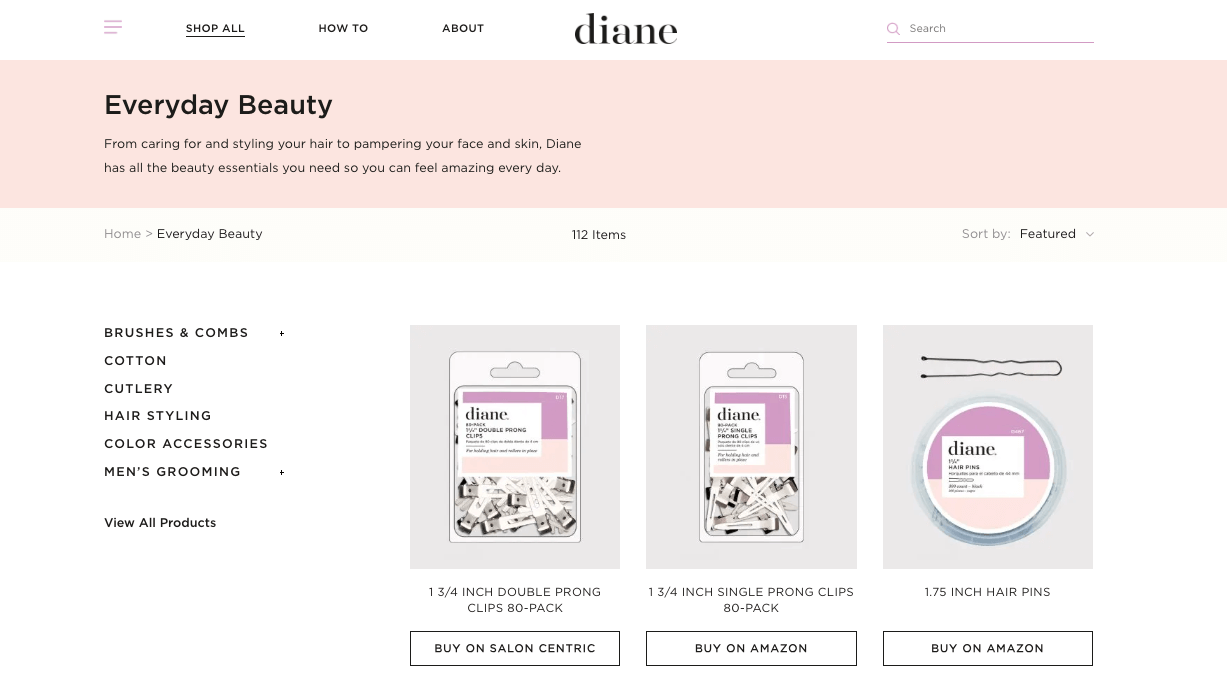
Follow Diane Beauty’s lead and offer handy collapsible product menus, a custom search engine, and lists that show off best sellers and new items.
4) SEO. Google ranks “helpful” sites higher than others, prioritizing websites that regularly publish content that displays experience, expertise, authority, and trustworthiness (EEAT).
Now, put all of this together and imagine an online store that ignores maintenance:
- Slow loading speeds mean it takes ages to browse through the store catalog.
- It’s almost impossible to use the mobile site without pinching and zooming.
- It crashes regularly and has broken links that lead to dead or blank pages.
- It falls behind competitors in search listings, missing out on sales.
- Customers leave their carts empty or unprocessed at the checkout, never to return!
The good news is that all of this is avoidable with the help of an eCommerce website maintenance agency.
They handle the complex maintenance and security work, save you time and money, and help you avoid costly redesigns down the line by keeping your site in tip-top shape for years to come.
You’d join the fine company of Vancouver Foodie Tours, an online shopping business that came to StateWP (that’s us! 🤓) with a long stack of technical and performance issues.

After signing up, its website is completely error-free, loads quickly, and is packed with exciting store features. Customer satisfaction is through the roof!
How to Perform eCommerce Website Maintenance in 3 Steps
Doing eCommerce maintenance is a pretty tall order. If you’re convinced you want to go at it alone, we recommend following an eCommerce-focused maintenance checklist.
However, be warned – the time you spend on site maintenance is better spent running your business, speaking to customers, and delivering the online experience they crave. Like Vancouver Foodie Tours does.
That’s why we’ve concentrated our steps on explaining how to hire a proactive maintenance agency.
Skip ahead to step 1 if you’re knowledgeable about maintenance. Otherwise, let’s quickly break down some typical tasks, so you’re aware of what needs to happen in the background.
0. Understand what maintenance tasks an eCommerce firm needs
A good eCommerce website maintenance plan should include:
| Category | Tasks |
| 1. Hosting |
|
| 2. Security and updates |
|
| 3. Speed/performance |
|
| 4. Backups |
|
| 5. Testing |
|
| 6. Analysis |
|
| 7. SEO |
|
1. Decide what maintenance partner you’re looking for
The best partner handles all these tasks and is happy to take on custom requests whenever you need them.
It’s also good practice to think about what you value in a great online store before making a hiring decision.
For example, you might want a partner that supports premium web hosting and a staging site platform, where you can tweak your store without harming your customers’ live experience. Alternatively, if you just need a dedicated account manager to handle the website security basics and performance boosts, pick a provider that offers entry-level plans.
You should also browse live sites handled by maintenance providers to see how they perform. Do they look like our clients, Nutsite, with a mobile-friendly interface, secure payment options, speedy load times, and relevant, interactive content?

If so, you’re on the right track!
2. Find the right eCommerce website maintenance partner
The right partner is security-focused and understands how online storefronts and eCommerce sites work.
You need round-the-clock monitoring and uptime, and a lightning-fast user experience that won’t frustrate shoppers.
Besides, your partner needs to back up your credibility and encourage buyer confidence. It’s not unreasonable to expect them to go above and beyond, regardless of what they charge.
Look for a package that offers:
- Real-time analytics that drill deep into what motivates your buyers
- Access to a team of experts that fixes problems within hours of you asking for help
- On-demand backups, SEO optimization auditing, and robust firewall protection, all running in the background
3. Outsource website maintenance and optimize performance
Outsource your website maintenance to an expert agency and get:
- A serious advantage over rival stores in search results
- An instant performance boost to keep people engaged and shopping
- Background experts to keep your site healthy (with no need for you to risk downtime or take time off to fix it)
- Help to test new features to improve UX and boost your revenue
Spark Experiences, which sells private tours and days out around San Francisco, is a perfect example of a business with an online store that already benefits from the maintenance agency touch.

We maintain this website based on the WooCommerce engine. Spark relies on us to boost its site performance around its peak season every year – something we gladly do to offer the best customer experiences exactly when business is set to boom.
Get Started Today with WordPress eCommerce Maintenance
You could do all your maintenance tasks yourself, or leave them to a legacy provider to keep control of your project in-house, and stay within your comfort zone.
That said, DIY maintenance is a huge time drain, and minimal support won’t keep your store safe and performing at its best.
Alternatively, you could save yourself time, money, and effort and boost your profitability by partnering with an agency like StateWP on our Elite package.
It’s a no-brainer.
Priced from $630 per month, StateWP Elite offers a fantastic return on investment with dedicated account management and specialized eCommerce development support.
With our top-tier customer service, you also get content edits (5 hours/mo), which you can set aside for bigger projects further down the line.
Then, there’s our SEO auditing service, which is excellent for tweaking your site to keep it competitive as search behaviors and customer tastes change.
The Elite plan’s staging site platform lets you play around with your content and store features without worrying about taking your live site offline.
On top of all that, you also get 24/7 security monitoring, proactive updates, regular backups, site speed and performance optimization, and everything you need to keep your storefront safe, engaging, and ready for business.
Helen Sanderson Associates (HSA) is a StateWP Elite eCommerce partner that sees regular, tangible benefits from our website management and support.

The company turned to StateWP after struggling with its previous maintenance provider. It experienced temporarily patched-up errors and bugs that kept recurring, damaging performance and the buyer experience.
Since joining us, the site’s fortunes have completely turned around. On top of a 30% speed boost, HSA now benefits from reliable care that keeps its online storefront live at all times.
Want some of those benefits for yourself?
Get started with a free website audit and see how much our WordPress eCommerce maintenance could improve your load speeds and site usability.
Then, book a free 20-minute chat with Garrett, our CEO, and learn more about our Elite plan and how we can keep your store healthy while improving your online sales.
Maintenance for an eCommerce Website: FAQs
Here are a few commonly asked questions about eCommerce website maintenance that we can help clear up.
What are some best practices for maintaining an eCommerce website effectively?
- Updating your core files, plugins, and themes when needed
- Protecting your site with a firewall and a malware scanner
- Monitoring page loading speeds and enhancing performance by using caching and lazy loading
- Optimizing your site’s layout for mobile devices
- Regularly testing cart and form functions
- Partnering with an agency that specializes in eCommerce maintenance
What is the best eCommerce platform for WordPress?
- WooCommerce
- BigCommerce
- Easy Digital Downloads
- Shopify
- Ecwid
You can save serious time and effort by choosing the right eCommerce platform by partnering with a website maintenance company like StateWP. Our Elite plan is designed to offer comprehensive development support for online stores.
How much does it cost to maintain an eCommerce website?
The cost of website maintenance varies depending on its size, the number of features it has, and whether or not you handle it all yourself. You could spend thousands of dollars a month maintaining a large eCommerce site.
Much of this comes from paying for web hosting, a domain, software subscriptions, staging sites, security monitoring, data backups, and specialized eCommerce features. Plus, you lose time and money maintaining it yourself.
For the best value for money, consider hiring a comprehensive eCommerce maintenance partner, such as StateWP, to handle it all for you from $630 a month on our Elite plan.